
Double Collapse, Double Crisis: How Hudson’s Bay and Ssense Shattered Canadian Fashion Styling
What happens to Canadian Fashion Stylists when its strongest supports disappear at once?

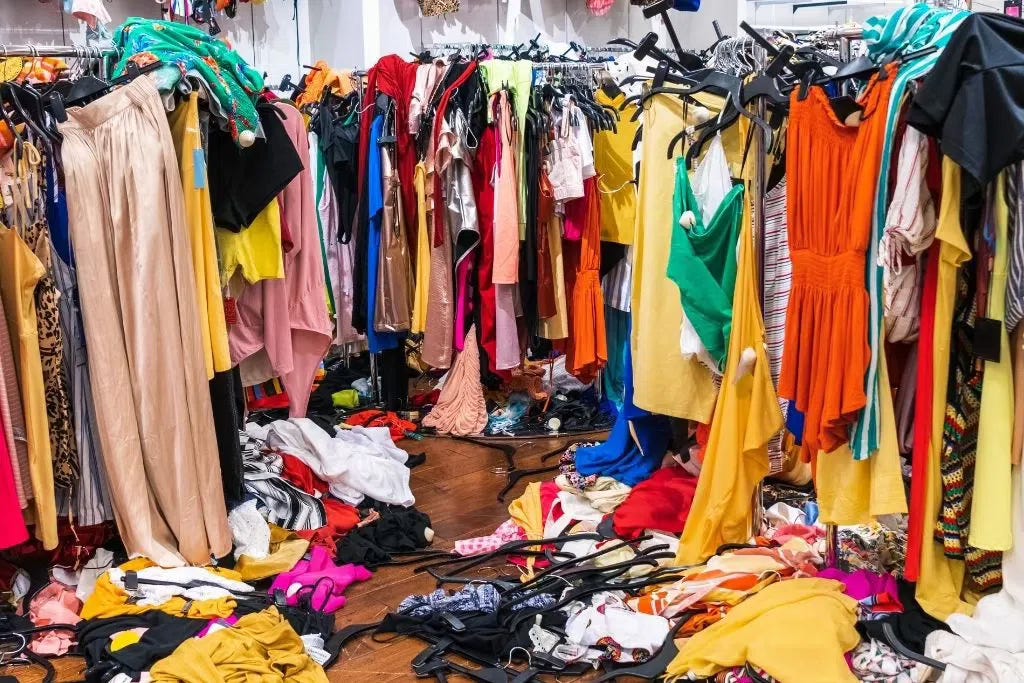
When I began working as a Production Artist Agent in the 2000s, the landscape for Canadian fashion stylists was stark. Outside of Holt Renfrew and Ogilvy (both of which maintained conservative selections) high-end retail was limited.
Production budgets rarely stretched far enough to cover duties and returns from early online pioneers like Net-a-Porter, and even the more then accessible ASOS often sat outside what was feasible once fees were factored in. Mid-range staples such as BCBG and French Connection UK for exemple, offered some relief, but eventually they, too, shuttered.
More than once, I saw productions forced to improvise hiring dressmakers and tailors to create custom pieces simply because nothing suitable was available. I even recall commissioning a made-to-measure skirt that replicated a Prada design for ELLE magazine, purely because the original look was beyond our reach.
It was also the beginning of a pattern: Canadian stylists constantly working around scarcity, filling gaps with creativity where infrastructure failed.
Hudson’s Bay as a Fashion Stylist’s Lifeline
For years, Hudson’s Bay was our industry lifeline.
Unlike most retailers, it understood the unique needs of stylists. Hudson’s Bay ran a department designed to accommodate us, offering special arrangements that made our work possible.
Hudson’s Bay’s value wasn’t just in its racks : it was about access. They carried an unmatched range of brands and sizes across price points, options otherwise available only online and at higher delivery cost.
For stylists, Hudson’s Bay also meant face-to-face relationships with sales associates. Restock fees where we paid a small percentage to temporarily take merchandise off the floor created a mutually beneficial system: stores gained visibility and compensation, while stylists gained the flexibility they needed to deliver.
Which is why, when Hudson’s Bay announced its closure earlier this year, stylists scrambled to patch together access anywhere they could, only to realize nothing could replace what had been lost.
Ssense: When the Giant Went Supernova
When Ssense expanded, it was revolutionary. As an e-commerce giant rooted in Montreal, it offered avant-garde, luxury, and emerging designers without the barriers of shipping delays or punishing duty fees. For the first time, stylists had direct, local access to brands we had only ever seen from afar.
With the opening of its flagship store, Ssense deepened its role. Stylists could bring clients for fittings or pick up orders in person, forging connections with personal shoppers and creating a hybrid model of e-commerce and physical access.
But this week’s bankruptcy filing has thrown the ground beneath us off balance. While Ssense remains technically open pending court proceedings, the uncertainty around refund policies makes placing large orders an impossible gamble.
If a stylist can’t take the risk of refund policies shifting overnight, it’s even less likely that a production will shoulder it for us. No one wants to gamble thousands of dollars on merchandise that may not be returnable tomorrow.
Why Physical Retail Matters
Those outside the industry often underestimate what physical stores absorbed for us. They allowed the messy, chaotic workflows of styling: pulling armfuls of clothes, returning the majority, and negotiating terms that worked for everyone.
E-commerce, by contrast, is unforgiving. High return rates trigger bans, often tied permanently to a credit card. Without human interaction, there’s no flexibility, no negotiation, and no acknowledgment of the editorial visibility stylists bring to brands.
As more retailers decline styling loans or restrict returns, we lose the very infrastructure that supported creative work in Canada. Stylists are left scrambling, piecing together wardrobes from fragmented sources at greater cost and greater risk.
The New Reality Post-Closure
So where does this leave us?
Budgets: Producers must adjust expectations. Stylists cannot deliver the same breadth of work within the same financial constraints. Styling expenses could double (or more) compared to 2024, and budgets need to reflect that reality upfront.
Lead Time: What was once possible within a few days may now take weeks. Productions must plan ahead and an early outreach is no longer optional, it’s essential.
Access: With the loss of major anchors, stylists will increasingly rely on small boutiques, direct designer loans, or resale/archival sources. The pool of options shrinks, and the flexibility once taken for granted is gone. What once could be solved with a single order now requires piecing together looks from fragmented vendors adding hours of research and coordination to every project. A return to made-to-measure is inevitable; in some cases, commissioning a custom piece may even prove less costly than sourcing abroad. But custom comes with longer timelines, and what was once possible in days now stretches into weeks.
Some niches may weather this storm, but for most, the loss is seismic.
Why This Moment Is Alarming
The closure of Hudson’s Bay’s stylist program and Ssense’s collapse are not isolated incidents : they represent a simultaneous unraveling of two pillars of Canadian fashion infrastructure. Either loss on its own would have been destabilizing. But both happening in the same year signals a correlation that is truly alarming.
Together, they mark not just the loss of stores, but the collapse of a system that Canadian stylists depended on to bring visions to life. The breadth of available brands has shrunk dramatically, and the infrastructure that once supported editorial, commercial, and celebrity styling has fractured.
Without these anchors, productions will be forced to rethink what’s possible: either increasing budgets dramatically, or accepting a diminished range of choices on set.
The Bottom Line
With Hudson’s Bay and Ssense collapsing in tandem, that cost has never been higher. The Canadian fashion ecosystem has always thrived on resilience. But resilience comes at a price, and right now, that price is rising fast.
It’s a very grim time to be in the Canadian fashion industry. Hudson’s Bay was already a huge loss to both creatives and consumers alike, but SSENSE feels even closer to home somehow. I wonder if any Canadian boutiques will take this opportunity to expand + boost e-commerce?
Beau papier MM! Bien heureuse de te retrouver sur Substack 🫶🏼 I’ll read you, don’t stop writing; everyone needs to hear your voice!